The EU Commission Cloud Breach Exposes the Data Privacy Gap in AI Inference
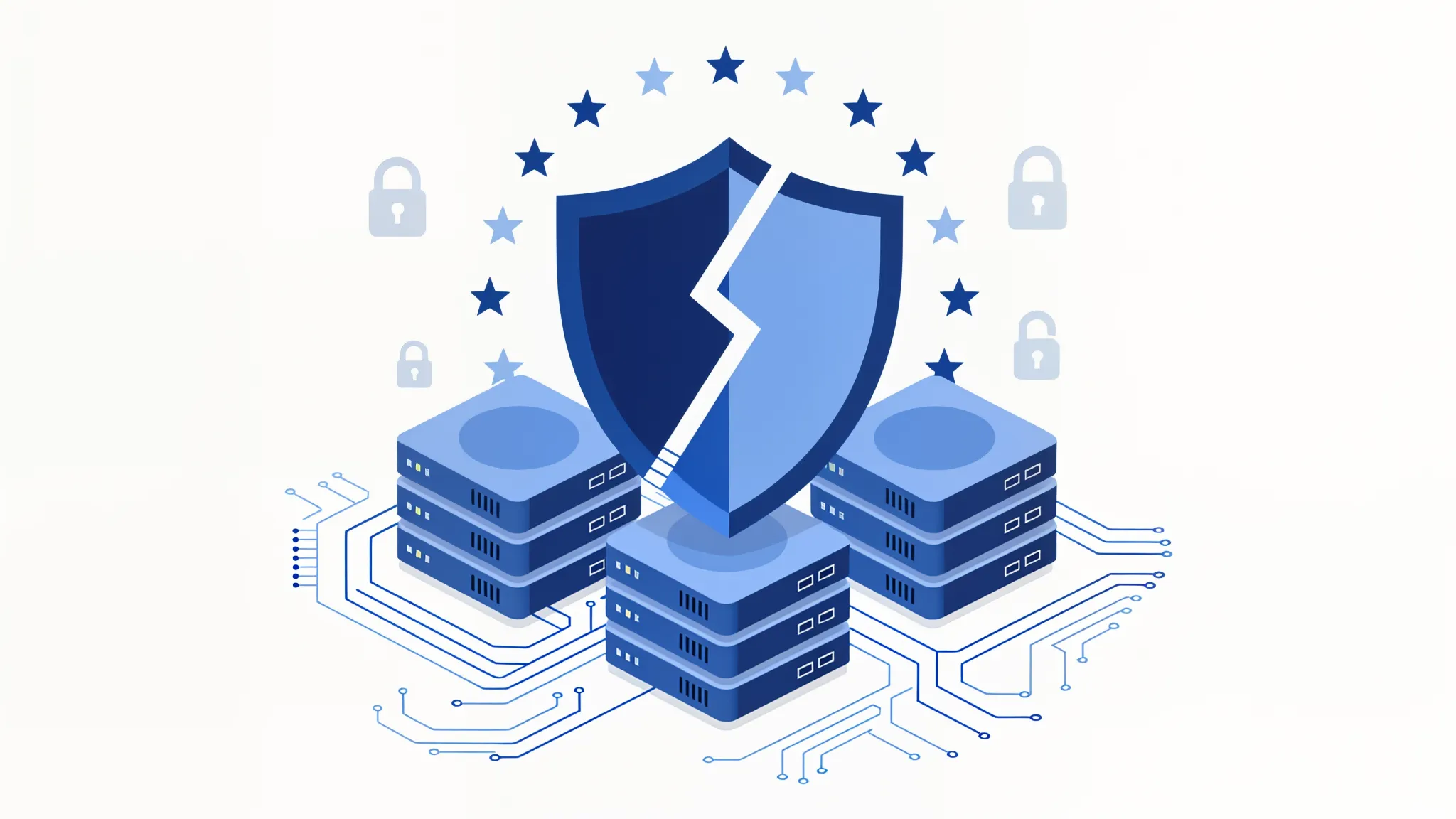
When the European Commission's own AWS cloud was breached in March 2026 and an estimated 350 GB of data was exfiltrated, it exposed more than institutional databases. It exposed the structural privacy risk that every EU company creates when it routes AI inference workloads through cloud infrastructure that sits outside EU jurisdictional control.
What the breach revealed about cloud data exposure
On 24 March 2026, the European Commission detected a cyber-attack on the cloud infrastructure hosting Europa.eu. The attacker exfiltrated databases, internal email, and staff data from the Commission's AWS environment. The breach appears to have stemmed from a misconfiguration, not an AWS vulnerability, which is how most cloud compromises begin.
The Commission confirmed that internal systems were unaffected, but everything in the cloud layer was exposed. That distinction matters. The data that was stolen was data that existed on infrastructure the Commission did not fully control: hosted, operated, and physically located within a US-headquartered provider's environment, subject to a different legal jurisdiction.
This was not an isolated incident. In January 2026, a separate breach hit the Commission's mobile device management via Ivanti EPMM. In 2021, EU institutions suffered an IT security incident under investigation. In 2018, suspected state-sponsored hackers accessed EU diplomatic cables. The pattern is consistent: EU institutions are high-value targets, and their cloud infrastructure is a persistent attack surface.
The data privacy problem for AI inference
The Commission's breach is a warning for any EU organization sending AI prompts through cloud-hosted APIs. When an EU company calls an LLM API hosted on a US cloud provider, the prompt, the completion, and any context injected into the request traverse infrastructure that has the same structural characteristics as the Commission's compromised AWS environment.
Under GDPR Article 28, a data controller must only use a processor that provides "sufficient guarantees" to implement appropriate technical and organizational measures. When the processor's infrastructure is operated by a non-EU cloud provider, the chain of subprocessors introduces jurisdictional ambiguity. The data may physically reside in an EU data center, but the provider is incorporated in the US, subject to the CLOUD Act, and may be compelled to disclose data without the controller's knowledge.
This is not theoretical. The Schrems II decision in 2020 invalidated the EU-US Privacy Shield precisely because US surveillance law gave US authorities access to EU personal data transferred to US providers, without adequate redress for EU data subjects. The EU-US Data Privacy Framework replaced it in 2023, but its durability remains contested, and it does not eliminate the underlying jurisdictional tension.
Why private cloud inference matters
The Commission breach illustrates a specific risk: data that exists on infrastructure you do not control is data you cannot fully protect. For AI inference, this means:
| Risk | US-hosted API | EU-only private cloud inference |
|---|---|---|
| Jurisdiction | US CLOUD Act applies | EU law only |
| Subprocessor oversight | Opaque, changes without notice | Published, vetted list |
| Data retention | Provider-defined, often 30 days | Zero Data Retention enforceable |
| Breach notification | Subject to US timelines | GDPR 72-hour rule applies directly |
| Regulatory audit | Limited visibility | Full audit trail available |
Private cloud inference does not eliminate all risk, but it removes the jurisdictional layer that makes GDPR compliance structurally fragile. When every subprocessor in the chain is EU-incorporated, EU-hosted, and subject to EU law, the controller's Article 28 obligations become enforceable rather than aspirational.
The subprocessor chain is the attack surface
The Commission's breach was not a direct attack on AWS. It was a misconfiguration that the attacker exploited. In AI inference, the equivalent risk is the subprocessor chain. When an EU company uses a US-headquartered AI provider, the data path typically includes:
- The API provider (e.g., OpenAI, Anthropic)
- The cloud infrastructure provider (e.g., AWS, Azure, GCP)
- Any intermediate services (CDN, logging, observability)
Each link in this chain is a potential point of failure for data privacy. The API provider may log prompts for abuse monitoring. The cloud provider may be subject to government access requests. Intermediate services may retain metadata. Under GDPR Article 28(2), the controller must ensure that any processor it appoints can demonstrate compliance, but when the chain crosses jurisdictions, the practical ability to verify compliance drops sharply.
This is why a published subprocessor list matters. If you cannot see every entity that processes your data, you cannot assess whether your Article 28 obligations are met. ozeye maintains a full subprocessor list where every provider is vetted for EU incorporation, EU data center hosting, and EU jurisdiction.
Zero Data Retention is a privacy control, not a feature
Most AI API providers retain prompts and completions for a period, typically 30 days, for abuse monitoring and model improvement. This is a data retention practice that creates a privacy exposure. If the infrastructure is breached during the retention window, the data is available for exfiltration, exactly as happened with the Commission's databases.
Zero Data Retention (ZDR) means that prompts and completions are never written to persistent storage by any provider in the inference chain. This is not the same as "we delete after 30 days." ZDR is an architectural guarantee that the data does not exist on disk after the API response is returned, which eliminates the exfiltration risk entirely for that data class.
The Commission breach shows what happens when data is retained on cloud infrastructure: it becomes a target. ZDR removes that target. When evaluating AI API providers, the question is not whether data is deleted eventually. The question is whether data is ever stored at all. See how ozeye handles data retention for the specifics.
What EU companies should do now
The Commission breach is a signal event, but the underlying risk has been present since EU companies started routing AI workloads through US-cloud-hosted APIs. Three concrete steps:
First, map the subprocessor chain for every AI API in use. If any subprocessor is non-EU-incorporated or hosted outside the EU, document the jurisdictional risk and assess whether the GDPR Article 28 requirements are genuinely met.
Second, require Zero Data Retention from AI inference providers. If prompts and completions are retained, they are a liability. The Commission's 350 GB exfiltration started with data that existed on cloud infrastructure. Do not let your AI prompts become the next dataset.
Third, evaluate EU-only inference routes. Multi-provider fallback routing across EU-incorporated, EU-hosted providers eliminates single-provider dependency, addresses the concentration risk that DORA Article 29 identifies, and keeps every data processing step under EU jurisdiction.
The European Commission was a high-value target, and the breach was significant. But the structural lesson applies to every EU organization: when your data is on infrastructure you do not control, in a jurisdiction you cannot enforce, the privacy guarantees in your contracts are only as strong as the legal framework that backs them. EU-only inference makes that framework enforceable.